1 Tesalonicenses 5:17
Oren sin cesar.
1 Tesalonicenses 5:17
Oren sin cesar.
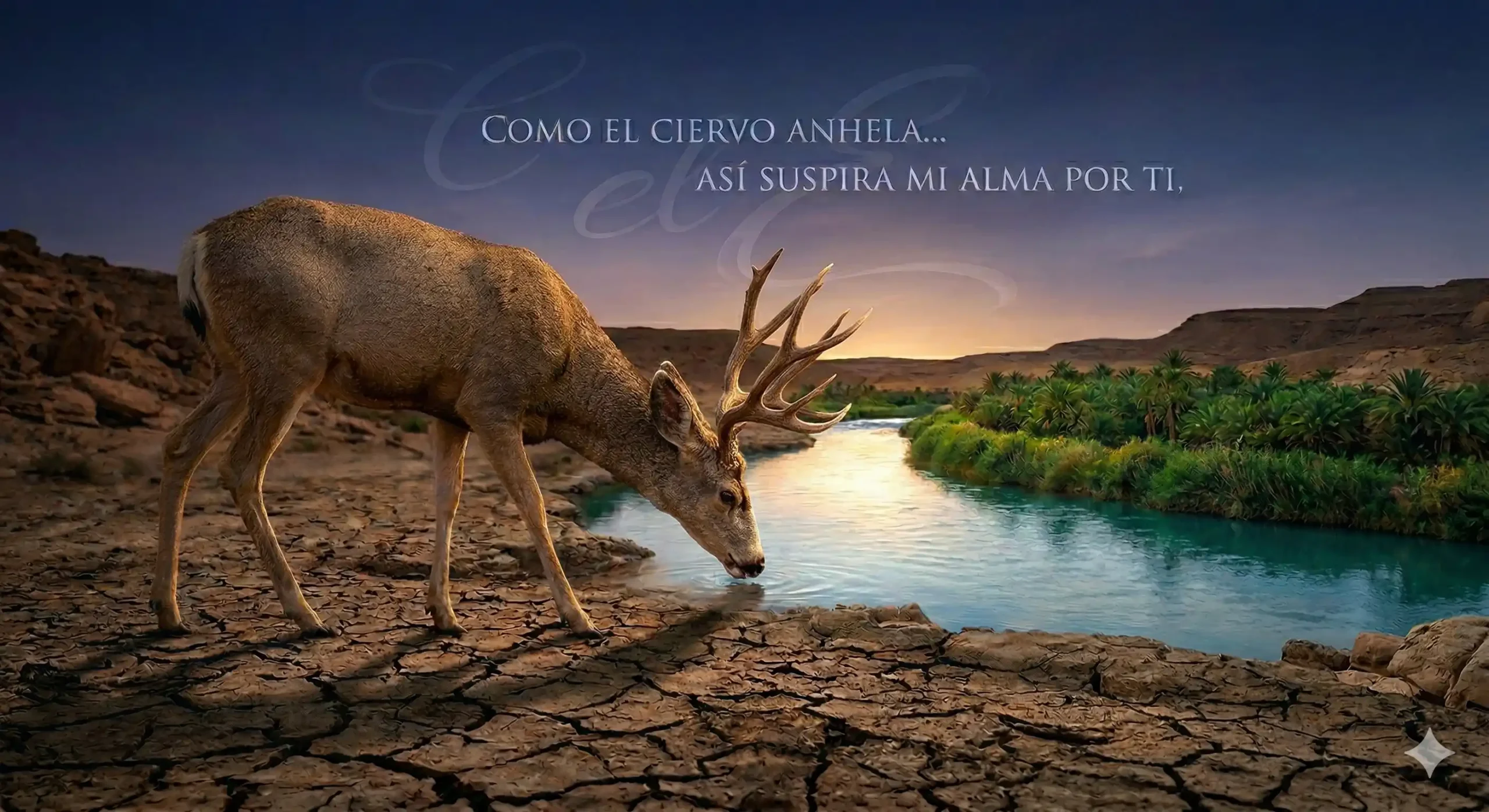
Psalm 42, particularly its opening verses, offers us one of the most powerful images to describe the intensity of the spiritual life: the soul’s thirst for God. The Psalmist begins with a deep and natural analogy: “As the deer pants for the water brooks, so my soul pants for You, O God”.
This comparison is not an exaggeration, but an illustration based on a real and vital necessity.
The figure employed is that of a deer, an animal that, during times of drought or water scarcity, emits a sharp sound or a “braying” of anguish and desperation. This cry, easily recognizable by those who lived in that environment, indicated an urgency for survival. Water is not a luxury or a sugary drink that only satisfies the palate; it is the vital and essential need for the creature’s body to subsist.
By using this figure, the Psalmist establishes a crucial point:
Mankind, like the thirsty deer, will exhibit anguish and despair when lacking the living God, the only one essential for its spiritual survival.
Humanity has an innate thirst for God, but we are often deceived into seeking substitutes. The enemy, like a dishonest merchant, does not offer “pure water” (the living God), but instead sells us chemical products or sugary drinks masquerading as the solution, such as philosophies, pleasures, or romantic relationships.
The Psalmist clarifies his search by saying: “My soul thirsts for God, for the living God”. This distinction is fundamental, for the idols of this world “are not alive”; they are deaf, mute, and cannot respond. Only the living God is capable of attending to and hearing the needs of those who cry out to Him.
The intensity of this necessity is manifested in the Psalmist’s lament: “My tears have been my food day and night”. Paradoxically, tears are his sustenance because they contain his hope. Scripture teaches that God stores the tears of His people in a bottle and treasures their prayers, giving them incalculable value.
For the Psalmist, pouring out his heart and his tears before God is not an act of defeat, but an act of faith that will be preserved and not ignored. Therefore, he concludes with a question full of hope: “When can I come and appear before God?”.
The Psalmist tells himself: “Hope in God, for I shall again praise Him for the help of His presence”. The anguish is temporary, but the salvation and presence of God are a certainty. Desperation leads to seeking, and seeking will be answered with the certainty of salvation.